What types of exoplanets orbit pulsars? This is what a recent study published in The Astrophysical Journal Letters hopes to address as a team of scientists investigated an exoplanet with unique atmospheric characteristics orbiting a pulsar. This study has the potential to help scientists better understand the formation and evolution of exoplanets orbiting pulsars, of which only a handful have been discovered.
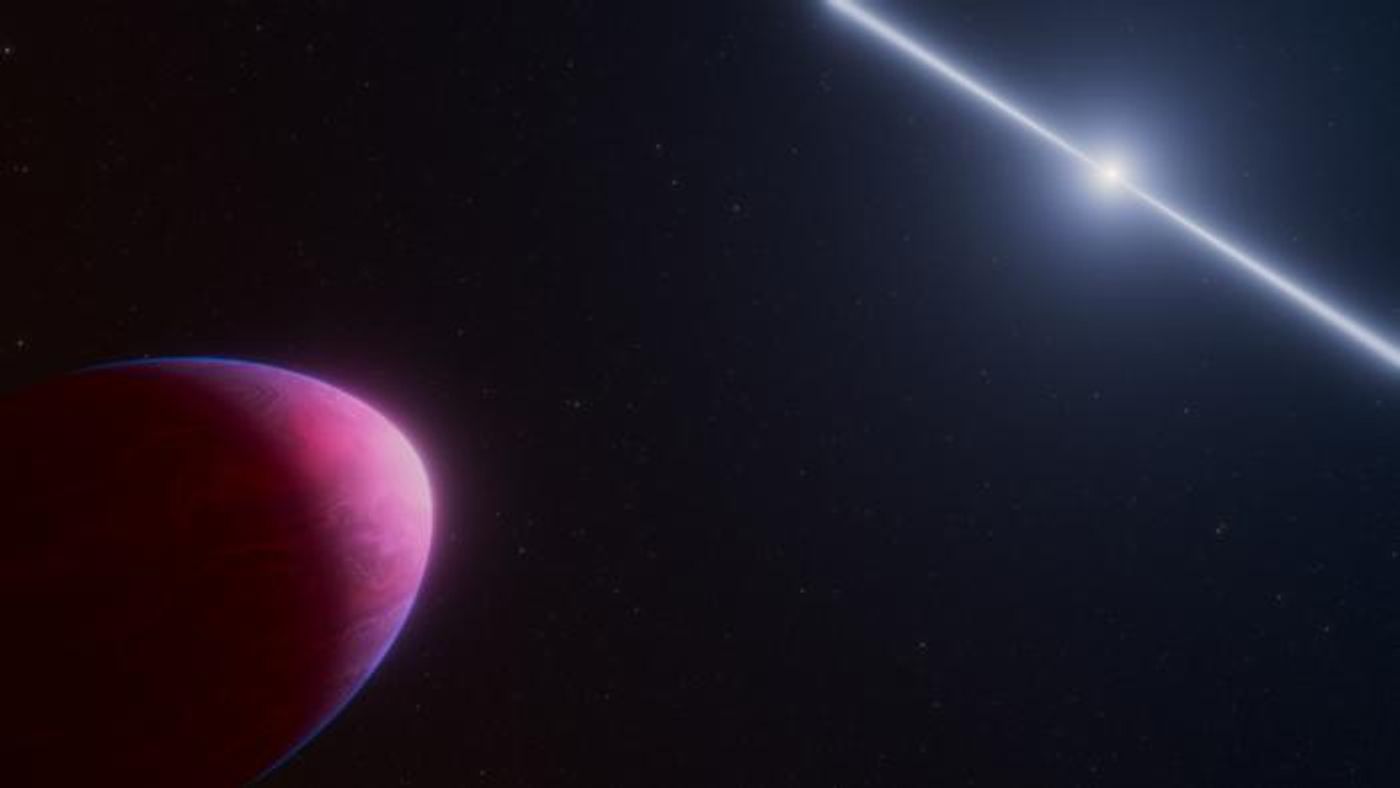
For the study, the researchers used NASA’s powerful James Webb Space Telescope (JWST) to observe PSR J2322–2650b, which is a Jupiter-sized exoplanet approximately 750 light-years from Earth and an orbital period of 0.3 days, designating it an a “hot” Jupiter. in fact, PSR J2322–2650b orbits so close to its host star that it has become stretched into a lemon shape. What also makes PSR J2322–2650b unique is its atmosphere is high in carbon, which the astronomers note challenges exoplanets that orbit main-sequence stars like our Sun.
Credit: NASA, ESA, CSA, Ralf Crawford (STScI)
Instead, PSR J2322–2650b orbits a pulsar, which is a fast-spinning neutron star that emits large amounts of gamma rays. Both the pulsar and its exoplanet companion are considered a “black widow” system, which typically consists of two pulsars with one consuming the other, causing the consumer to spin faster. However, astronomers have designated PSR J2322–2650b as the companion, which only orbits 1 million miles from its host star. The unique atmospheric composition of PSR J2322–2650b challenges traditional models of exoplanet formation and evolution, which also contains a unique interior potentially comprised of diamonds to complement its atmosphere.
“As the companion cools down, the mixture of carbon and oxygen in the interior starts to crystallize,” theorized Dr. Roger Romani, who is a Professor of Physics at Stanford University and a co-author on the study. “Pure carbon crystals float to the top and get mixed into the helium, and that's what we see. But then something has to happen to keep the oxygen and nitrogen away. And that's where there's controversy.”
What new insight into pulsar exoplanets will researchers make in the coming years and decades? Only time will tell, and this is why we science!
As always, keep doing science & keep looking up!
Sources: The Astrophysical Journal Letters, EurekAlert!