How can earthquakes contribute to ocean life? This is what a recent study published in Nature Geoscience hopes to address as a team of scientists investigated a connection between seismic activity and phytoplankton growth. This study has the potential to help scientists better understand the connection between geology and biology and whether this is a worldwide connection.
For the study, the researchers analyzed satellite data regarding phytoplankton blooms located at the Australian Antarctic Ridge, the latter of which is in the Southern Ocean and separates the Australian Plate from the Antarctic Plate. Phytoplankton blooms consume iron for food, and researchers hypothesized that phytoplankton blooms existing near the Australian Antarctic Ridge originated from iron at hydrothermal vents. The goal of the study was to ascertain a link between seismic activity, which occurs at boundaries of tectonic plates, to iron-fed phytoplankton blooms. In the end, the researchers found that phytoplankton bloom growth could be predicted months in advance by seismic activity.
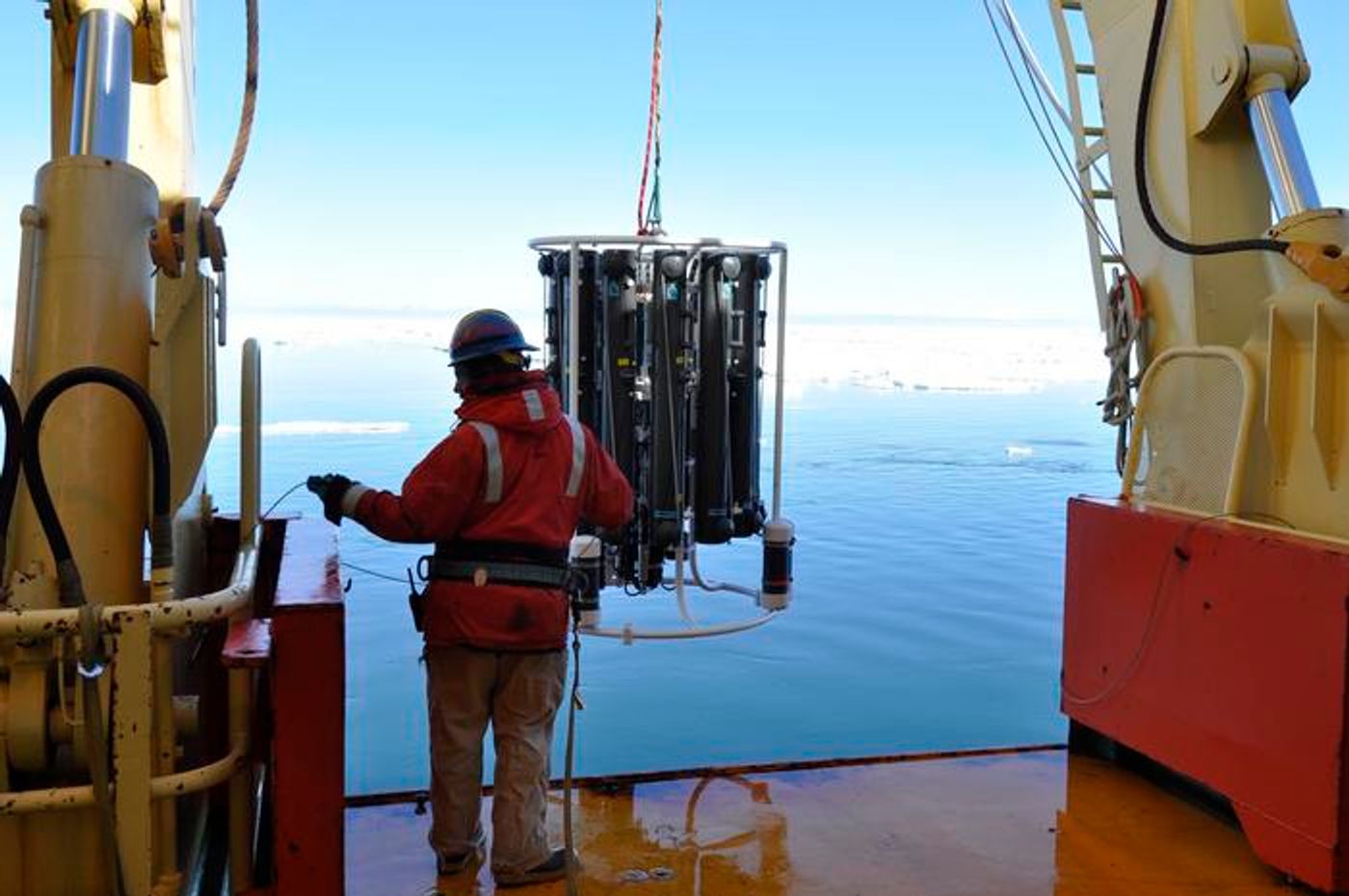
Lowering a scientific instrument into the northern Ross Sea to gather water samples from varying depths and measure their iron content. (Credit: Gert van Dijken)
“When looking back over satellite observations of this bloom, we’ve seen it swell to the size of the state of California or down to the size of Delaware,” said Dr. Casey Schine, who is a postdoctoral research associate at Middlebury College but conducted some of the research as a PhD student at Stanford University and is lead author of the study. “Our study ultimately showed that the main factor controlling the size of this annual phytoplankton bloom was the amount of seismic activity in the preceding few months.”
Going forward, the researchers aspire to build on these findings, which challenge longstanding hypotheses regarding a connection between geology and biology, by exploring how much carbon dioxide that phytoplankton blooms consume as they grow based on seismic activity.
What new insight into earthquakes and phytoplankton will researchers make in the coming years and decades? Only time will tell, and this is why we science!
As always, keep doing science & keep looking up!
Sources: Nature Geoscience, EurekAlert!