
Postdoctoral Research Fellow in the Hein Lab
University of British Columbia
BIOGRAPHY
MAR 18, 2026 5:30 AM PDT
Lowering the Learning Curve in Laboratory Automation with IvoryOS
Presented at:
Laboratory Automation Virtual Event Series 2026
Speaker
Abstract
Laboratory automation has made major progress in recent years, driven by advances in robotics, instrumentation, and data analysis. In practice, however, building and running automated workflows is still difficult for many laboratories. Software stacks, runtime and orchestration are often fragmented, integration is highly customized, and effective use typically requires strong programming expertise. This talk presents IvoryOS, an open-source orchestration platform designed to make lab automation easier to build and adopt while also supporting hands-on learning. Instead of relying on a new domain-specific language or framework, IvoryOS inspects existing Python protocols to extract metadata and build interoperable interfaces. This provides an instantly operable runtime and separates hardware control from experimental logic and optimization, improving reuse, reproducibility, and maintainability. IvoryOS allows scientists to design and run autonomous workflows through a visual interface, enabling researchers to get started in a single day. As workflows grow more complex, researchers can gradually engage with the underlying Python code, learning programming skills in context rather than upfront. It has been deployed on more than 20 robotic systems, including educational platforms across academic and industrial labs.
Learning Objectives:
1. Explore orchestration and adoption challenges in lab automation
2. Discover how IvoryOS lowers the barrier of building and operating self-driving laboratories
3. Demonstrate how visual orchestration supports hands-on automation and progressive skill development
You May Also Like
FEB 17, 2026 | 8:00 AM

In cell therapy applications, commonly employed cell purification platforms for large-scale isolation of immune or stem cells separate cells based on a single cell surface antigen. Enrichmen...
FEB 18, 2026 | 8:00 AM
With advancing food allergy research and emerging therapies, new allergy testing requirements arise. In this context, Basophil Activation Testing (BAT) has emerged as an essential component...
FEB 18, 2026 | 1:00 PM

Energy-efficient filtration solutions that reduce hidden chemical exposure from benchtop work and lab equipment to improve overall laboratory safety...
FEB 19, 2026 | 8:00 AM
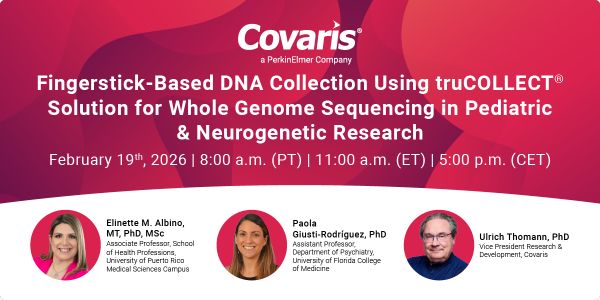
The collection of high-quality genomic DNA remains a major barrier in pediatric and neurodevelopmental research, particularly among children with autism spectrum disorder (ASD) and other neu...
FEB 23, 2026 | 9:00 AM
C.E. CREDITS

Explore decentralized liquid biopsy with SOPHiA GENETICS and MSK-ACCESS®, expanding access, improving outcomes, and accelerating precision oncology....
FEB 23, 2026 | 11:00 AM
The timing of the biological onset of multiple sclerosis (MS) is unclear. We used high-throughput discovery proteomics and samples from presymptomatic patients with MS and matched healthy co...
Loading Comments...