
Associate Professor (Clinical) of Pathology, Division Medical Director, Genetics, Co-Program Director, Clinical Genetics Fellowship Program, Program Director, Molecular Genetics Fellowship Pr
BIOGRAPHY
AUG 22, 2013 10:00 AM PDT
Clinical Interpretation of Sequence Variants
Presented at:
Genetics and Genomics Virtual Event Series 2013
Speaker
Abstract
The advent of massively parallel sequencing by next generation sequencing platforms now allow genomic approaches for individualizing healthcare. Genomic sequencing data reveals variants in genes related to drug metabolism that may affect efficacy or response. This presentation will describe the potential of NGS data for companion diagnostics or therapeutics and its implementation into clinical laboratories. Evaluating pharmacogenetic targets through exome analysis as well as through targeted gene panels will be discussed.
You May Also Like
FEB 17, 2026 | 8:00 AM

In cell therapy applications, commonly employed cell purification platforms for large-scale isolation of immune or stem cells separate cells based on a single cell surface antigen. Enrichmen...
FEB 18, 2026 | 8:00 AM

With advancing food allergy research and emerging therapies, new allergy testing requirements arise. In this context, Basophil Activation Testing (BAT) has emerged as an essential component...
FEB 18, 2026 | 1:00 PM

Energy-efficient filtration solutions that reduce hidden chemical exposure from benchtop work and lab equipment to improve overall laboratory safety...
FEB 19, 2026 | 7:00 AM

Discover how Iconeus One, the premier functional ultrasound (fUS) system for neuroscientists, is transforming brain function studies. Based on ultrafast plane-wave sonography, Iconeus One of...
FEB 19, 2026 | 8:00 AM
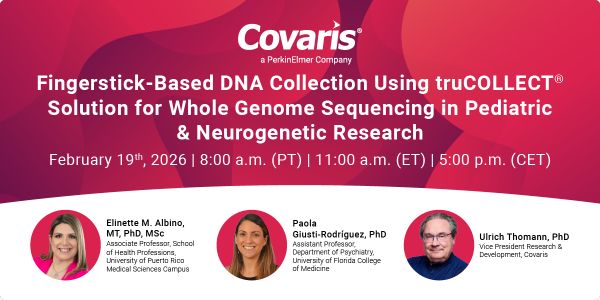
The collection of high-quality genomic DNA remains a major barrier in pediatric and neurodevelopmental research, particularly among children with autism spectrum disorder (ASD) and other neu...
FEB 23, 2026 | 9:00 AM
C.E. CREDITS

Explore decentralized liquid biopsy with SOPHiA GENETICS and MSK-ACCESS®, expanding access, improving outcomes, and accelerating precision oncology....
Loading Comments...