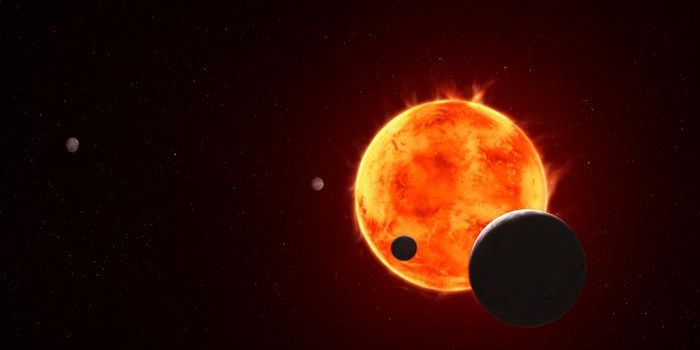
Are Sun-like stars the only stars where Earth-like worlds exist? This is what a recent study presented this morning at the 2026 meeting of the American Astronomical Society hopes to address as a team of researchers investigated how K dwarf stars could be suitable locations for finding life beyond Earth. This study has the potential to help researchers better understand where to search for life beyond Earth, even around stars unlike our Sun.
For the study, the researchers conducted a first-time survey of more than 2,100 K dwarf stars spread across a volume of 40 parsecs (130 light-years), with K dwarf stars being smaller and cooler than our Sun. Using data obtained from telescopes in Chile and southern Arizona, the researchers learned about the atmospheric properties of the K dwarf stars, specifically regarding their stellar activity. In the end, the researchers discovered that the number of K dwarfs stars within the study volume were double the number of G type stars, such as our Sun. Additionally, the researchers found that approximately 10 percent of the K dwarf stars examined for the study were active.
“This survey marks the first comprehensive look at thousands of the Sun’s lower-mass cousins,” said Sebastián Carrazco-Gaxiola, who is an Astronomy PhD student at Georgia State University and lead author of the study. “These stars, known as ‘K dwarfs,’ are commonly found throughout space, and they provide a long-term, stable environment for their planetary companions.”
While K dwarf stars are smaller and cooler than our Sun, this also means their lifespans are far greater, estimated to be 15-40 billion years. For context, our Sun’s lifespan is approximately 10 billion years, and it’s halfway through its life at the moment. Therefore, given their enormous lifespans, K dwarf stars have recently become targets for astrobiology and habitable worlds where life as we know it could exist.
What new insight into K dwarf stars will researchers make in the coming years and decades? Only time will tell, and this is why we science!
As always, keep doing science & keep looking up!
Sources: American Astronomical Society, EurekAlert!
Featured Image: Artist's illustration of a habitable world orbiting a K dwarf star. (Credit: NASA Ames/JPL-Caltech/Tim Pyle)